


Helsinki Launches Legacy Toolkit at IBTM World to Help Associations Create Lasting Impact
Magazine:
20th Nov, 2026
Category:
Image:

Body:
South Harbour in Helsinki © Janne Hirvonen | Helsinki Partners
Unveiled at IBTM World in Barcelona, the new resource aims to help event organisers translate legacy ambitions into practical initiatives, drawing on a regional approach that connects international congresses with local communities, research and innovation.
Helsinki Convention Bureau has launched its new Helsinki Legacy Toolkit at IBTM World, placing the long-term contribution of business events at the centre of its destination strategy. The resource is designed to help organisers identify opportunities within their events to generate lasting benefits for local communities, while aligning those initiatives with the objectives of both the event and its host destination.
The launch builds on work already under way across the Helsinki Capital Region, where Helsinki, Espoo and Vantaa are developing a shared approach to event impact. As explored in Headquarters’ exclusive report published in May, Inside the Helsinki Capital Region: Where Happiness Meets Business, the three cities combine their respective strengths in international congress hosting, research and innovation, creating opportunities for events to engage with the region's wider knowledge ecosystem.
Legacy is gaining importance in the business events and association congress sectors, although translating the concept into measurable outcomes remains a challenge for many organisers. A 2026 survey commissioned by BestCities Global Alliance and ICCA as part of the Incredible Impacts research found that 67% of associations would consider a destination they might otherwise overlook if it offered a compelling legacy opportunity.
For Helsinki, the toolkit builds on the connection between events and the wellbeing of the communities that host them. Finland has topped the World Happiness Report for the ninth consecutive year, and the capital is using this positioning to encourage organisers to consider how their events can contribute to that wider picture.

The Brain Health School Challenge was launched in Helsinki in 2024 by European Academy of Neurology © Toni Kilpinen / Pixduo
From legacy ambitions to practical action
Developed for the Helsinki Region, the Legacy Toolkit helps planners identify local strengths and opportunities, then translate them into place-based initiatives with social, economic and environmental value. Its approach is based on the idea that creating a positive impact does not necessarily require redesigning an entire event. Instead, organisers can make intentional choices at key stages of the planning process.
The resource offers a flexible framework for developing initiatives that reflect the priorities of the event and the destination. Helsinki also sees international events as an opportunity to test new approaches locally, using the city as a testbed for ideas that could subsequently be developed and scaled at European or global level.
The region already has examples of this approach in practice. One is the Brain Health School Challenge, launched in Helsinki in 2024 in collaboration with the European Academy of Neurology. Developed alongside the Academy's congresses in 2024 and 2025, the initiative encouraged pupils and students at different educational levels to develop projects and campaigns focused on brain health. Its impact has continued beyond the congress programme: in 2026, the awards ceremony brought pupils and students from across Finland to Helsinki for the third time.
Another example highlighted in HQ’s May report is the European Conference on Operational Research, held in Espoo in 2022. Bringing nearly 1,900 participants to Aalto University, the event strengthened international collaboration while connecting the conference with the region's academic and research environment.
These initiatives illustrate how legacy can be built through partnerships with associations, universities, researchers and local stakeholders. As the report also explored, the Helsinki Region's approach is not simply to manage individual projects, but to facilitate connections that allow organisers to work with local expertise and identify opportunities for longer-term outcomes.
“In Helsinki, wellbeing and happiness are built through small, everyday moments. As the capital of the happiest country in the world, we want the events we host to contribute to that happiness story. Legacy is not only about creating lasting benefits for the destination, but also about making events more meaningful, rewarding and memorable for those who attend,” said Karoliina Ala-Opas, Head of Helsinki Convention Bureau at Helsinki Partners.
“Every event has the potential to create value that lasts for people, sectors and the destination. With the Legacy Toolkit, we want to help organisers recognise that potential, turn their ideas into action and demonstrate the lasting relevance of their events,” she added.
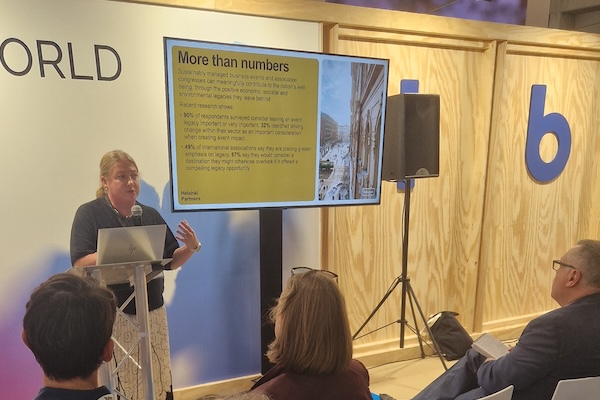
Karoliina Ala-Opas presenting the Legacy Toolkit to journalists at IBTM World
A regional approach to event impact
The toolkit was developed as part of the KOKEMO project, a regional collaboration between Espoo, Helsinki and Vantaa. The initiative aims to position the Helsinki Region as a global benchmark for event impact and measurable legacy, bringing together the three cities around a shared approach to attracting and hosting international events.
The ambition is also reflected in Helsinki’s city strategy for 2025–2029, which identifies attracting international events and congresses as a priority. The region's wider strengths support this ambition: Helsinki brings experience in hosting international congresses, Espoo contributes a strong academic and research dimension through institutions such as Aalto University, while Vantaa provides an international gateway through Helsinki Airport and its surrounding conference and hospitality infrastructure.
The destination already has a strong position in the international meetings market. Helsinki ranked 20th among the world's most popular meeting cities in 2025, according to the Union of International Associations, and has held first place in the Global Destination Sustainability Index for three consecutive years.
With the Legacy Toolkit, the city is seeking to build on these credentials by giving organisers a practical framework to consider what their events can contribute after the delegates have left.

Public Brain Health Day 2025 © Andrew Rinkhy European Academy of Neurology
Powered by Meeting Media Company, publisher of Headquarters Magazine (HQ) – a leading international publication based in Brussels, serving the global MICE industry and association community.
Other Articles


HQ Global
HQ Asia Pacific



About Us
Supported by the European Society of Association Executives (ESAE) and the Union of International Associations (UIA), Headquarters Magazines serve the needs of international associations organizing worldwide congresses.
Supported by the European Management Assistants Association (EUMA), European Cities Marketing (ECM) and Site, MIM Europe is designed for corporate meetings and incentives planners based all over Europe.
© Meeting Media Group, 2014.
Latest Issues


Cover Image:

HQ #127 / Proving Our Worth: Influencing Policy through Evidence and Collective Action
28th Oct, 2026
Older Issues